- Academic writing
- Research
- Citations
How to paraphrase academic sources without plagiarism
Paraphrasing a source still needs a citation. How to avoid patchwriting, when to quote instead, and a sentence-by-sentence routine for research writing.
· 2 min read
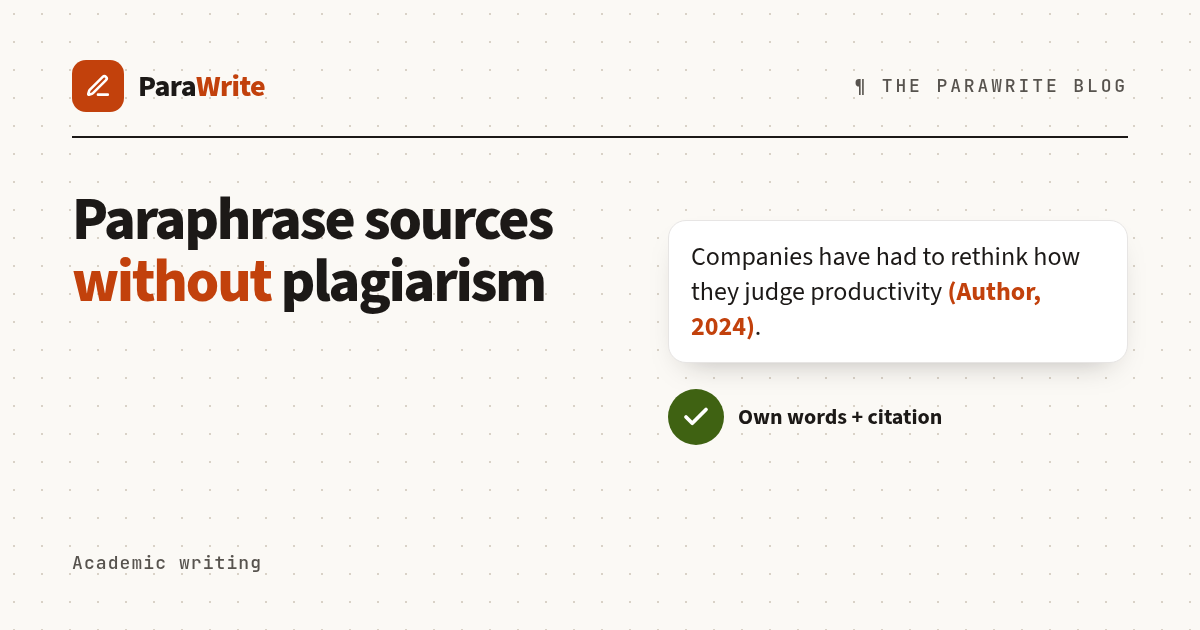
A paraphrase is your own wording of someone else's idea. The wording is yours; the idea is still theirs, so it still needs a citation. Most accidental plagiarism in research writing comes from forgetting one half of that: either the paraphrase stays too close to the source's wording, or the citation gets dropped because "I rewrote it".
This post covers how to paraphrase sources properly. Your institution's academic integrity policy is the final word on what is required, so check it too.
Does a paraphrase need a citation?
Yes. Citing tells the reader where the idea came from. Rewording changes the expression, not the origin. The usual rule of thumb:
| You are using… | Do you cite? |
|---|---|
| A direct quote | Yes, with quotation marks |
| A paraphrase of a specific idea, finding or argument | Yes |
| A summary of a source | Yes |
| Common knowledge in your field | Usually not |
| Your own original analysis | No |
What is patchwriting?
Patchwriting is when you keep the source's sentence structure and swap some words for synonyms. It looks like a paraphrase, but it's really a lightly edited copy. Even with a citation, many institutions treat it as a problem.
Source: The rapid adoption of remote work has fundamentally altered how organisations measure productivity.
Patchwritten: The quick uptake of remote work has basically changed how companies measure productivity.
Paraphrased: Since remote work spread, companies have had to rethink how they judge whether people are productive (Author, Year).
The patchwritten version follows the original word for word in structure. The paraphrase rebuilds the idea.
When should you quote instead?
Quote when the exact words matter: a definition, a striking phrase, a claim you are about to dispute, or wording that can't be changed without losing precision. Paraphrase everything else. A paper made mostly of quotes reads as a collection of other people's voices.
A routine for paraphrasing sources
- Read the whole passage first, not just the sentence you need.
- Close the source and write the idea from memory.
- Compare your version with the original: same meaning, different structure?
- Keep technical terms, names and numbers exactly as they are.
- Add the citation straight away, while you still know where it came from.
- Mark anything copied with quotation marks immediately, so it can't turn into accidental plagiarism later.
Paraphrasing your own drafts
Research writing also involves rewriting your own text: drafts that echo a paper you read too closely, or sections reused from an earlier write-up. Check your institution's rules on reusing your own previous work, and treat close echoes of a source like any other paraphrase.
How ParaWrite fits in
ParaWrite won't add citations or check for plagiarism. It does make the routine above easier. It splits your text into sentences, keeps the original above your rewrite, and shows the sentences around it. The splitter also keeps "Dr.", "et al." and decimals like "p < 0.05" together, so each screen holds one real sentence. At the end, the Changes view lets you compare every rewritten sentence with its original before you submit.