- How-to
- Manual paraphrasing
- Writing
How to paraphrase without changing the meaning
A step-by-step method for rewriting a sentence in your own words while keeping exactly what it says, with examples and a checklist.
· 3 min read
Paraphrasing means saying the same thing in different words. The hard part is the first half of that sentence: the same thing. Most bad paraphrases aren't badly written. They are well written and slightly wrong. This is a method for keeping the meaning fixed while the wording changes.
What counts as "the meaning" of a sentence?
Before you rewrite anything, pin down what must survive. For most sentences that is four things:
- The claim. What is being said to be true?
- The strength. "May", "suggests", "shows" and "proves" are different claims.
- The scope. "Some", "most", "all" and "in this study" set limits that must stay.
- The relationships. Cause, contrast, sequence, condition. "Because" is not "although".
If your version keeps all four, the meaning is intact, however different the words are.
Step 1: Read the sentence in context
A sentence borrows meaning from its neighbours. "This approach failed" only makes sense if you know which approach. Read the sentence before and after the one you are rewriting, so your version still connects to them. (This is why ParaWrite shows the surrounding text while you edit.)
Step 2: Say it out loud without looking
Look away and explain the sentence as if to a friend. What you say is usually a decent first paraphrase, because you are working from the idea, not from the words. If you can't explain it, you don't understand it well enough to rewrite it yet.
Step 3: Change the structure, not just the words
Swapping words for synonyms keeps the original's skeleton and often its exact phrasing. Change how the sentence is built instead:
- Turn passive into active, or the reverse.
- Move the main clause to the front.
- Split one long sentence into two, or join two short ones.
- Turn a noun phrase into a verb ("the reduction of costs" becomes "cutting costs").
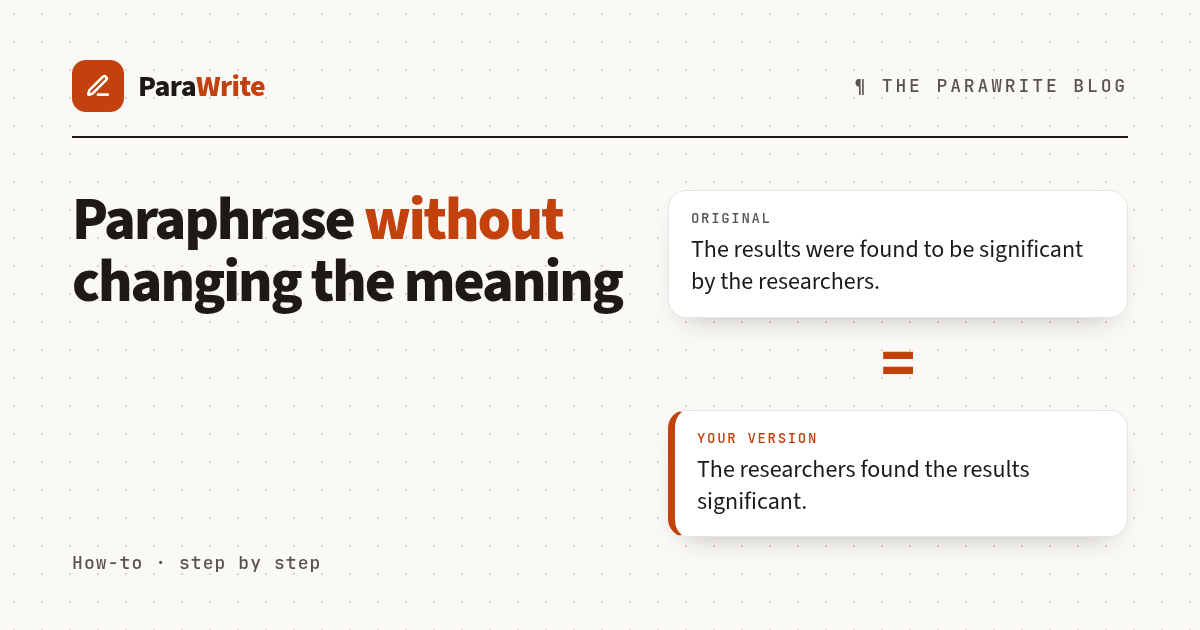
Original: The results of the study were found to be significant by the researchers.
Paraphrase: The researchers found the results significant.
Step 4: Keep the technical terms
Not every word should change. Field-specific terms, names, numbers and defined concepts usually must stay as they are. A "near-synonym" for a technical term is often a different concept. Change the sentence around the term, not the term.
Step 5: Check it against the original
Put the two side by side and run the four checks from the top:
| Check | Question to ask |
|---|---|
| Claim | Does mine say the same thing is true? |
| Strength | Did "may" become "does", or the reverse? |
| Scope | Did I drop or add "some", "most", "all", "often"? |
| Relationships | Is cause still cause, and contrast still contrast? |
If any answer is no, fix that before moving on.
Step 6: Read the paragraph back
A run of individually correct sentences can still read badly together. When you finish a paragraph, read it as a whole. Fix repeated words and abrupt transitions.
A quick checklist
- I understood the sentence before I rewrote it.
- I changed the structure, not only the vocabulary.
- Technical terms, names and numbers are unchanged.
- The claim, strength, scope and relationships all match.
- The paragraph still reads smoothly.
Doing this sentence by sentence
The method works best one sentence at a time, with the original in view and the context around it. That is exactly the workflow ParaWrite is built for: it splits your text into sentences, keeps the original above your version, and shows every change next to its original at the end.
If you paraphrase sources for research, also read how to paraphrase academic sources without plagiarism.